COPPER BEECH (Fagus sylvatica f. purpurea)
History & Uses of the Wood
The Copper Beech is a cultivated form of our native Beech, long known as the “Mother of the Forest” for the way it dominates the woodland around it. Its close-grained, hard-wearing timber has been prized for centuries for furniture, flooring and tool handles. Strong and remarkably smooth, the wood was the natural choice for book boards — and the connection runs deeper still. Thin beech-wood writing-tablets and sections of bark were among the earliest European writing surfaces; bound together, they formed the first collections of pages. The Anglo-Saxon word for beech is bōc, and from it we derive our modern word book.
Myths & Folklore
In folk tradition the Beech was considered a wishing tree — lovers carved their initials into its smooth, silver-grey bark, a practice so widespread that parkland Copper Beeches across Sussex still bear the scars of centuries of courtship. Along the Rother Valley, ancient beeches served as parish boundary markers, their great limbs offering meeting places and shelter.
A Haven for Insects
The dense canopy supports a wealth of moth species whose caterpillars feed on its foliage, among them the Barred Hook-tip, Clay Triple-lines and the elegant Olive Crescent — all found across the woods of Sussex. In spring, the freshly opened leaves attract aphids and other sap-feeders, which in turn draw ladybirds, hoverflies and parasitic wasps. Below ground, the Beech develops an intimate partnership with mycorrhizal fungi — sharing sugars in return for nitrogen and scarce minerals.
Benefits to Birds & People
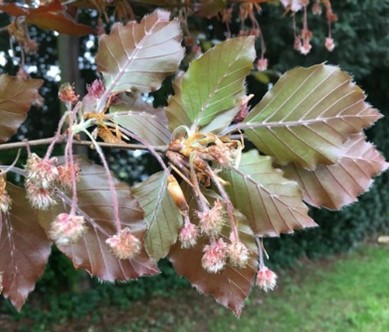
The dense crown offers nesting cover for woodland birds, while the autumn crop of beech mast is eagerly taken by bramblings, chaffinches, nuthatches, wood mice, voles, squirrels, deer and badgers. In spring, its leaves open a deep, lustrous purple-green, edged with a delicate gossamer fringe that falls away as the leaf hardens. Come autumn, the foliage turns rich copper and gold — and many leaves, reluctant to fall, cling to the branches through winter, rustling in the wind long after other trees stand bare. Commanding, graceful and reaching some 30 metres, it is one of the Rother Valley’s most magnificent trees.