
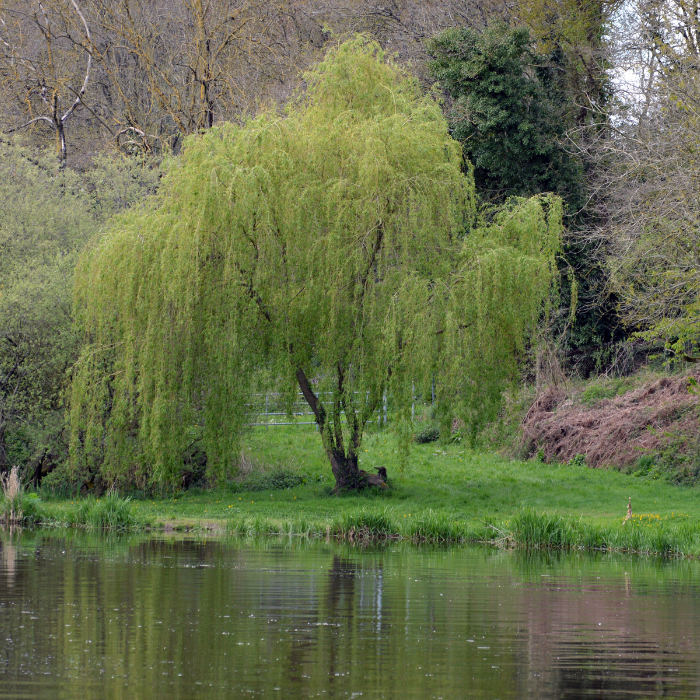
Weeping Willow (Salix Babylonica)
History & Uses of the Wood
The Weeping Willow is not a native tree but has graced the English landscape since around 1730, when it is thought to have been introduced from Aleppo in northern Syria. It grows rapidly to a height of 20 to 25 metres but has a relatively short lifespan of 40 to 75 years. Its long, sweeping curtains of foliage make it one of the most instantly recognisable trees along the rivers and ponds of Sussex. The timber is soft, light and supple — of little use for construction but traditionally valued for making cricket bats, artificial limbs and light packing crates. The flexible young shoots were woven into baskets and fish traps, while the bark yielded salicin, the natural compound from which aspirin was first derived.
Myths, Folklore & Legend
Few trees carry such weight of sorrow and poetry. Napoleon was fond of the Weeping Willow and was buried beneath one on St Helena. The name babylonica derives from a misunderstanding by the great botanist Linnaeus, who believed this was the tree described in Psalm 137 of the King James Bible: “By the rivers of Babylon, there we sat down, yea, we wept, when we remembered Zion. We hanged our harps upon the willows in the midst thereof.” In truth, those trees were not willows at all but the Euphrates Poplar (Populus euphratica), which has willow-like leaves and drooping shoots — a confusion corrected in the New International Bible of 1978, which names them as poplars. Willows at the water’s edge were thought to weep for the drowned, and country folk were wary of sleeping beneath one after dark.
A Haven for Insects & Moths
The long female catkins appear in April, rich in nectar and pollen at a time when few other trees are in flower. Honeybees, bumblebees, butterflies and early hoverflies feed eagerly on them. The narrow, spirally arranged leaves support moth caterpillars including the Eyed Hawk-moth, the Puss Moth and the Sallow Kitten — all recorded across Sussex. Aphids colonise the foliage in numbers, drawing ladybirds, lacewings and blue tits.
Benefits to Birds & People
The dense, cascading canopy offers sheltered nesting for moorhens, sedge warblers and reed buntings. Grey wagtails hunt insects beneath the trailing branches, and kingfishers perch on low boughs. Its roots bind riverbanks and reduce erosion. Elegant, fast-growing and eternally romantic, it is one of the most beloved waterside trees.